
Querying
While some of the property definition in the example may have felt a bit verbose (we’ll get into more patterns later to help manage the redundancy), but it starts to pay off by the expressiveness from being able to query all the information in your workspace.
First, let’s update the workspace config file to tell Knowboard we want to enable the SPARQL server:
# ...exclude = [".git/**"]
[sparql_server]listen = "auto" # or specific port like "17878"Knowboard provides a simple web-based SPARQL UI.
In VSCode the UI can be opened using the Command Pallete:
Cmd+Shift+P (Mac)Ctrl+Shift+P (Windows)
> Knowboard: Open SPARQL UI
Knowboard also provides a Code Lens in the .knowboard.toml config to open
a browser to the UI:
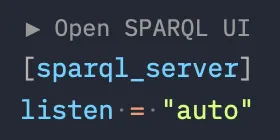
Or if you have a specific port defined, you can navigate directly to it in the browser, such as http://localhost:17878.
Knowboard can also be used with a variety of standard SPARQL clients
Testing a query
Section titled “Testing a query”In SPARQL the basic “show me everything” query looks like this:
SELECT * WHERE { ?subject ?predicate ?object } LIMIT 3This should return a selection of the information we’ve defined in the workspace like:
| subject | predicate | object |
|---|---|---|
| tag:me@example.com,2026:my-workspace/authors/jane-austen | http://schema.org/name | Jane Austen |
| tag:me@example.com,2026:my-workspace/authors/jane-austen | http://www.w3.org/1999/02/22-rdf-syntax-ns#type | http://schema.org/Person |
| tag:me@example.com,2026:my-workspace/authors/f-scott-fitzgerald | http://schema.org/name | F. Scott Fitzgerald |
Structuring the results
Section titled “Structuring the results”To get something more insightful, SPARQL enables us to query the structure and connections between different items, such as associating book titles with the author’s name:
PREFIX schema: <http://schema.org/>
SELECT ?bookName ?authorName WHERE { ?book a schema:Book ; schema:name ?bookName ; schema:author ?author . ?author schema:name ?authorName .}| bookName | authorName |
|---|---|
| The Great Gatsby | F. Scott Fitzgerald |
| Pride and Prejudice | Jane Austen |
See the references for additional SPARQL resources.